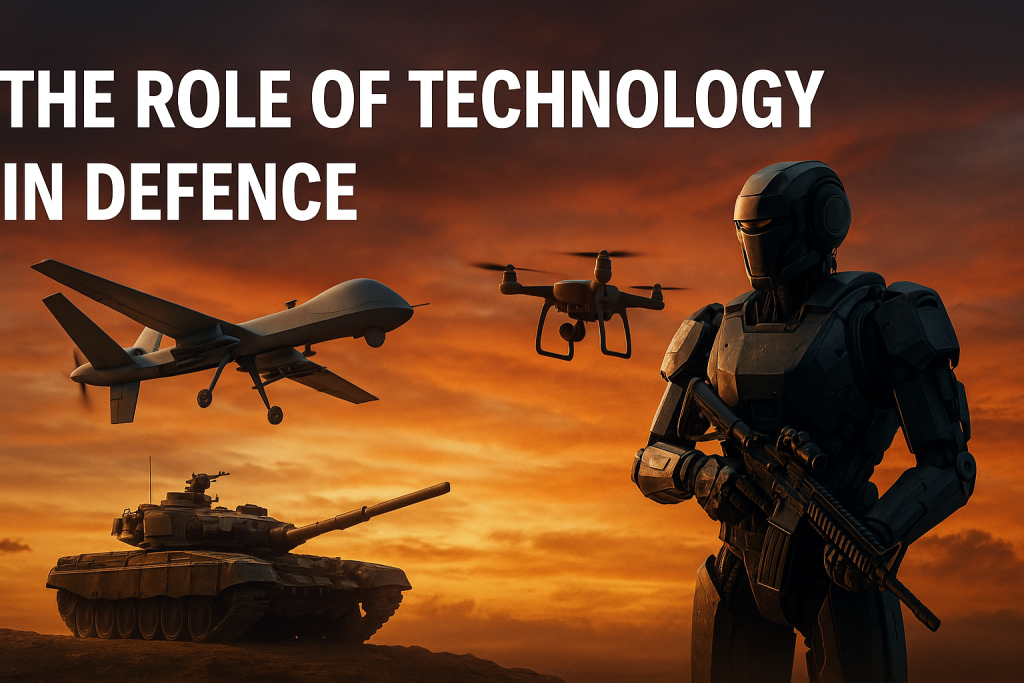

Modern battlefields are increasingly dominated by unmanned aircraft and munitions. Today’s drones span the gamut from high-end surveillance platforms to swarms of cheap “kamikaze” quadcopters, transforming how militaries conduct reconnaissance, strike, and networked operations. In fact, recent analyses estimate that in the Russia–Ukraine conflict drones account for roughly 70–80% of battlefield casualties. As armed forces scramble to field these systems, three converging trends define this drone revolution: autonomy (AI-powered decision-making), swarms and collaborative behavior, and indigenous production and supply chains. The result is a fast-growing defense market – projected from about $40.5 billion in 2024 to some $87.6 billion by 2030 – as nations race to integrate drones into every corner of warfare.
Key battlefield roles. Modern military drones fulfill several critical missions. First and foremost is persistent ISR (Intelligence, Surveillance, Reconnaissance). Long-endurance MALE/HALE UAVs (like the USA’s MQ-9 Reaper or Israel’s Heron) patrol contested airspace and borders, using high-resolution cameras and multi-spectral sensors to detect threats. Advances in onboard computing mean much of the image analysis happens “at the edge,” allowing drones to flag camouflaged vehicles or hidden missile sites in real time without always sending video back to base. Second is precision strike. Armed drones and loitering munitions loiter near target areas and then plunge in with warheads. Examples range from heavy winged UCAVs firing guided missiles hundreds of kilometers away, down to small tube-launched “loitering munitions” or first-person-view (FPV) quadcopters that dive into tanks or artillery with explosive payloads. Third is electronic warfare (EW). Drones now carry jamming pods, radar decoys, or cyber-attack payloads. Conversely, drone makers are hardening their systems – for instance, Ukrainian engineers introduced fiber-optic tethering so FPV drones can remain connected in GPS- and radio-jammed environments. Fourth, manned–unmanned teaming (loyal wingmen) is emerging: small tactical drones that fly alongside fighters (providing sensor coverage or decoying threats) are under development in several air forces. Finally, a growing naval and multi-domain role sees aerial drones coordinated with unmanned surface vessels (USVs) and ground vehicles. For example, Ukraine has begun using small drone boats to launch swarms of FPV drones from the sea, even incorporating unjammable fiber-optic communication to reach inland targets despite electronic warfare.
-
Persistent ISR & targeting. Drones now carry advanced multi-sensor suites and SATCOM links for 24/7 surveillance over vast areas. They serve as “eyes in the sky,” feeding live data to commanders and even lasing targets for cruise missiles or artillery.
-
Loitering munitions (kamikaze drones). Combining aspects of missiles and UAVs, these systems hover until a high-value target appears. They have become iconic weapons of asymmetric warfare, used to destroy tanks, air defenses, and ships. Russian Kalashnikov ZALA Lancet drones, for instance, have been upgraded to double their endurance (up to ~50 minutes) and range, making them even deadlier.
-
Electronic warfare. Some drones jam enemy radars and communications from standoff distances; others resist jamming. Both sides in Ukraine started stringing fiber-optic cables to FPV drones in late 2024 so the pilot stays connected even under heavy jamming. New drones can also spoof GPS or carry AESA radars and cyber tools to blind opponents.
-
Loyal wingmen (manned–unmanned teaming). Semi-autonomous combat drones that fly with fighter jets are under active development globally. In 2025, US Air Force F-15 and F-16 pilots successfully controlled Kratos XQ-58A Valkyrie “loyal wingman” UAVs during training flights, a key milestone for the USAF’s future Collaborative Combat Aircraft program. China is reportedly prepping its own FH-97 stealth “loyal wingman” for flight testing with J-20 fighters. These systems can act as both sensor platforms and weapon carriers, taking on riskier tasks (like drawing enemy fire) to protect manned jets.
-
Naval and multi-domain operations. Drones have extended to the seas and ground. Ukraine’s “Magura” and other USVs have launched drone attacks on Russian ships and coastal targets. Notably, Ukraine has begun deploying fiber-optic FPV drones from unmanned boats, creating jam-resistant attack chains from sea to land. On land, armies experiment with drone trucks and even mortar-like tube launchers for swarming attack drones.
https://gbhardwaj.com/wp-content/uploads/2025/12/Drone-animation-1.mp4
Emerging trends. Several technological and operational patterns stand out across militaries:
-
Mass production and attrition strategy. Drones are now built cheap and in quantity. Countries like Russia and Ukraine produce thousands of small loitering drones per month, treating them as expendable weapons. This war of attrition style has prompted high-end powers to rethink priorities toward large “attritable” fleets of lower-cost drones that can be lost without breaking the bank. In the US, for example, programs like “Replicator” aim to flood battlefields with inexpensive autonomous drones.
-
AI-enabled autonomy. Artificial intelligence is embedded in targeting and flight control. AI-powered targeting increases hit rates (Ukrainian analysts note FPV kill accuracy jumped from ~30–50% to ~80% with AI assistance). Autonomous navigation lets drones plan complex routes or operate when communication is lost. The growing “kill web” concept means drones, satellites, ships, and ground units share data in real time – hardware is becoming secondary to the software brain that runs the mission.
-
Cooperative swarming. Multiple drones now coordinate attacks, overwhelm defenses, or perform complex reconnaissance patterns. Swarm tactics – from synchronized drone “taxi-bombers” to sensor networks – are under development, giving small units new force-multiplying options. (One recent US Army experiment involved a single soldier controlling multiple drones to rapidly adapt on the fly.)
-
Counter-jamming and resilience. With electronic warfare omnipresent, resilience is key. Drones now use frequency hopping, encrypted links, inertial navigation back-ups, and even fiber tethers (as noted) to survive on hostile EM battlefields.
-
Multi-domain integration. The future battlespace will blend air, sea, land, and cyber. Drones increasingly carry out joint missions: aerial drones cue artillery, ground drones relay communications, and surface drones hunt subs or land targets. Unifying command-and-control (C4ISR) networks is crucial. For instance, the US DoD’s 2024 Collaborative Combat Aircraft (CCA) program explicitly aims to fuse manned fighters and unmanned platforms with shared data links
https://gbhardwaj.com/wp-content/uploads/2025/12/Drone-animation-2.mp4
Accordingly, defense procurement reflects this drone surge. The global military drone market is booming – analysts forecast nearly a doubling of market value from around $40.5 billion in 2024 to $87.6 billion by 2030. This growth is concentrated in regions with rising tensions: North America still leads (over 39% share in 2024), but Asia-Pacific is rapidly expanding under “Make in Country” policies. Governments are boosting budgets for unmanned capabilities in ISR, strike, and counter-drone defenses alike.
The upshot is clear: modern warfare is quickly shifting toward unmanned systems. As Field commanders witness drones producing the lion’s share of combat effects in Ukraine, militaries worldwide are scrambling to adapt their tactics, training, and procurement. In short, the drone revolution – powered by AI, swarming, and domestic production – has become the backbone of 21st-century combat power.
Disclaimer: This article is generated with the help of AI especially for image and video generation. Also the information mentioned in this article is taken from different news, documentary and reports published by media houses and defence journals. Credit goes to original creator.
Sources: Authoritative defense and news reports: spslandforces.com, economictimes.indiatimes.com, nationalinterest.org, businessinsider.com, defensenews.com, airandspaceforces.com, quwa.org, defensenews.com, economictimes.indiatimes.com, warroom.armywarcollege.edu, grandviewresearch.com