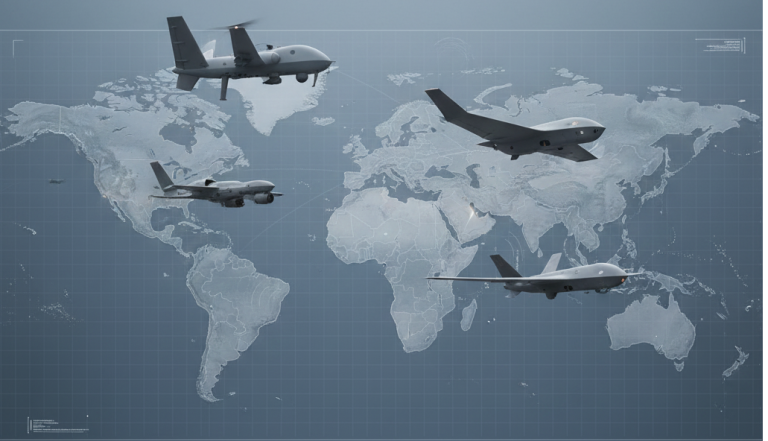
Beyond these general trends, each major military power has forged its own drone strategy and “hero” platforms. Below we examine key developments by country, illustrating how different forces are deploying and developing UAVs for modern conflict:
India: Indigenous Push with Select Imports
India has shifted rapidly from relying on imports to building a local drone industrial base. After years of setbacks (the indigenous TAPAS-BH MALE UAV was reportedly scrapped in Jan 2024 after failing to meet performance targets), India is aggressively procuring advanced drones while nurturing domestic design. One example is buying Israeli Heron MK-II MALE drones: India is adding more Heron MkIIs via emergency procurement and plans to co-produce them locally. These satellite-linked HALE UAVs (45-hour endurance, 35,000 ft ceiling) will bolster surveillance along high-altitude borders. Concurrently, the DRDO is advancing indigenous UCAV projects. The stealthy Ghatak jet-powered UCAV (based on the SWiFT prototype) and other classified developments aim to give India a “loyal wingman” UAV in the 2020s. On the tactical side, Indian forces have experimented with drone swarms (even running live demos of hundreds of FPV kamikazes) for deep-strike and SEAD missions. Private-sector start-ups (supported by defense corridors) are building smaller ISR and loitering drones to protect frontiers and critical sites.
Overall, India’s drone doctrine blends imported platforms for immediate needs (e.g. Heron Mk II for reconnaissance) with a long-term focus on Make-in-India. Programs like “Project Cheetah” are retrofitting its Heron fleet with missile strike capabilities, potentially creating an indigenous armed variant. The ambition is clear: India’s flagship UAV is evolving from the unarmed TAPAS to a future akin to an Indian Heron-900 or Ghatak UCAV, symbolizing self-reliance in airpower.
Russia: Mass Production & Heavy Stealth UCAV
Russia has doubled down on quantity and ruggedness. On one front, it is mass-producing simple drones and loitering munitions. For example, the Kalashnikov ZALA Lancet-3 FPV kamikaze drone has proven highly effective in Ukraine (sinking tanks, artillery). In late 2025 upgraded Lancet models were unveiled with double the flight endurance (up to ~50 minutes) and ranges up to 45 km, making them harder to outrun. Reports suggest Russia aims to churn out “thousands” of such small drones monthly, often deployed in truck or helicopter “drone-swarm” launchers.
In parallel, Russia’s aerospace industry is fielding heavy stealth UCAVs. The Sukhoi S-70 Okhotnik-B (“Hunter”) is a large flying-wing drone (estimated 20–25 tons) designed to operate alongside Su-57 fighters. It has a reported ~6,000 km range and can carry several tons of weapons internally, extending the reach of manned jets in contested airspace. (The Okhotnik had its maiden flight in 2019 and was slated for production trials by 2024.) In practice, however, development has been rocky – one Okhotnik prototype was lost in 2024 – but it remains Russia’s poster UCAV. Thus, Russia’s “hero” UAVs are twofold: one cheap and numerous (FPV Lancets and converted commercial quadcopters as kamikazes), and one elite and stealthy (Okhotnik). Both pillars emphasize rugged design to survive harsh environments: Lancets can be flown into jamming zones where pricier drones would fail, and Okhotnik is built to operate in face of advanced air defenses.
Ukraine: The Innovation Lab of Drone Warfare
Ukraine stands out as the global testbed for unmanned tactics. Facing a larger adversary, Kyiv’s forces have industrialized DIY drones. Hundreds of private and state labs churn out FPV attack quadcopters for antitank strikes and trench warfare. Ukrainian units also build medium-winged drones for deep strikes. Uniquely, Ukraine has pioneered fiber-optic tethered drones: small quadcopters spooled to surface cables so they remain controllable despite Russian jamming. Notably, Ukrainian naval drone boats now serve as “motherships” that launch these wired drones from the Black Sea. In one reported raid, fiber-optic FPVs were carried aboard unmanned boats to strike targets on the Russian coast – a novel, “unjammable” sea-air strike chain.
Through this innovation, Ukraine treats drones as attritable assets in a long war of attrition. The slogan “sky is now our artillery” aptly describes thousands of $500 homemade drones dismantling multi-million-dollar tanks and air defenses. Its drone industry aims high: plans to double annual drone output to millions of units have been floated, feeding a strategy of distributed lethality. There is no single Ukrainian “hero” drone – rather, a family of modular FPV and surface drones forms a deadly ecosystem. Each new trick (e.g. networked swarm control, AI-based target recognition) is rapidly adopted on the front lines. In short, Ukraine has become a workshop for next-gen tactics, proving how low-cost, innovative unmanned systems can compensate for conventional deficits.
https://gbhardwaj.com/wp-content/uploads/2025/12/Drone-Article-2-Animation-1.mp4
Türkiye: From Bayraktars to the Kızılelma UCAV
Turkey has solidified its status as a global drone power by pairing combat-proven systems with cutting-edge R&D. Its Baykar company transformed the Bayraktar TB2 MALE UCAV into an export hit – used decisively in Syria, Libya, Nagorno-Karabakh and Ukraine. The TB2’s combination of simple maintenance, long endurance, and precision bombs shattered enemy armor columns and air defenses in multiple conflicts. Building on that success, Baykar developed the Akinci (an 8-ton larger turbofan UCAV) and now the Bayraktar Kızılelma (“Red Apple”). The Kızılelma is a jet-powered, stealthy unmanned fighter concept designed to operate from land bases and aircraft carriers alike. In November 2025, Turkey reported that a Kızılelma prototype scored a first-ever beyond-visual-range missile kill on a drone target. That flight – with Kızılelma in formation alongside five Turkish F-16s – signaled Turkey’s entry into fifth-generation drone aviation.
Another domestic program is the TAI Anka-III, a flying-wing stealth drone intended for SEAD (suppressing enemy air defenses). Meanwhile, Turkey leads in naval drones too (unmanned surface vessels) and has pursued MUM-T concepts linking its future KAAN fifth-gen fighter with autonomous wingmen. In summary, Turkey’s “hero products” are its Bayraktar UCAV family: the TB2 series for affordable precision strike and the upcoming Kızılelma UCAV for advanced networked aerial warfare. Türkiye’s trajectory shows a move up the value chain – from prop-driven drones to stealthy, supersonic autonomous combat jets.
Pakistan: Hybrid Fleet and Loitering Munitions
Pakistan’s drone arsenal is a hybrid mix of home-grown designs and foreign imports, reflecting its strategy of asymmetrical deterrence. Indigenous systems like the Burraq UCAV (akin to earlier Chinese designs) and the Shahpar series provide ISR and precision-strike roles. For example, the Shahpar-II is a turbo-prop MALE drone with autonomous takeoff/landing, showcased internationally as Pakistan’s in-house MALE class UAV. However, Pakistan has also co-produced and acquired foreign UAVs: it operates Turkey’s Bayraktar TB2 and China’s CH-4 and Wing Loong II drones, enhancing its surveillance and strike reach against insurgents or across the de facto borders. These collaborations include licensed assembly arrangements, giving Pakistanists direct access to datalinks, payload integration, and production know-how.
A recent focus has been loitering munitions. At IDEAS 2024, state-owned GIDS unveiled the Blaze family (25 kg, 50 kg, and 75 kg variants) of tube-launched attack drones. The smallest, Blaze-25, can loiter for 60 minutes over 75 km, carrying an explosive warhead for tactical strikes. Notably, each Blaze drone incorporates some autonomous targeting to overcome electronic warfare. These represent Pakistan’s move to decentralize air-to-ground firepower: infantry units can now launch guided drones to engage high-value targets on the move.
In essence, Pakistan’s strategy blends indigenous UCAV development (Shahpar, Burraq) with imported heavy lift (CH-4, Wing Loong, TB2) and now novel loitering drones (Blaze series) to punch above its regional weight. This layered approach bolsters its border surveillance and A2/AD (Anti-Access/Area-Denial) posture against India and threats in its periphery.
China: Advanced Loyal Wingmen and Swarm Power
China arguably fields the world’s largest and most varied military drone inventory. It still produces and exports mass-market MALE UCAVs (e.g. Wing Loong, CH series), but the PLA’s focus has shifted to high-end and swarm systems that complement its fifth-generation fighters. In public view is China’s emerging FH-97 combat drone. Dubbed a “loyal wingman,” the Feihong-97 is a stealthy UAV designed to fly alongside J-20 fighters, carrying electronic warfare gear and munitions. Leaked images suggest the FH-97 will debut as a combat-ready drone, potentially unveiling at the 2025 military parade. If confirmed, this would give China a first-mover advantage, fielding a purpose-built UCAV that can act as an “intelligent assistant” and mobile ammo pack for piloted jets.
Beyond that, Chinese industry is obsessed with drone swarms and networks. Laboratories report experiments coordinating hundreds of low-cost quadcopters via AI algorithms, reminiscent of sci-fi hive tactics. The PLA is also diversifying into naval drones (aerial and surface) to counter adversary navies, and even hypersonic unmanned gliders linked to anti-ship missiles. Perhaps the most visible system is the high-altitude WZ-7 “Soaring Dragon” reconnaissance UAV (a join-wing design), which loiters over the Pacific to cue Chinese missile systems. However, the FH-97 represents China’s immediate “hero” UCAV. It symbolizes how Beijing is integrating advanced autonomy and stealth into its drone fleet, anticipating large-scale cooperative missions under networked C4ISR.
In short, China’s drone posture is moving from commodity exports to cutting-edge loyal wingmen and multi-domain systems. Its massive commercial drone base (DJI and others) funnels R&D into military R&D, making China a leading innovator in swarm intelligence and AI-directed UAV warfare.
United States: Legacy Platforms and Next-Gen Loyal Wingmen
The US retains unparalleled experience with long-range MALE drones. The General Atomics MQ-9 Reaper (Predator B) continues as the workhorse MALE UCAV, logging thousands of flight hours for global ISR and precision strike (though combat deployments have slowed with the end of many overseas wars). However, the Pentagon’s priority has pivoted toward more survivable, networked, and attritable systems for future peer conflicts.
On one hand, the US is investing in small tactical drones and loitering munitions. Its UAV Arsenal now includes many portable kamikazes – from AeroVironment’s Switchblade 300 and 600 series to larger “XQM-179 PatrolLite” jets. The war in Ukraine highlighted the demand for such weapons. For example, Switchblade drones were so critical that AeroVironment announced in late 2025 plans for a new factory to boost production from about 500 per month to thousands. They even tested air-launching a Switchblade-600 from an MQ-9 drone for long-range strike, showing how US platforms might swarm and cross-arm launch in future fights.
On the other hand, the USAF is formalizing loyal wingman drone programs. The Kratos XQ-58A Valkyrie (a jet-powered stealth UAV) has flown multiple loyalty tests. In July 2025, USAF pilots in F-15 and F-16 fighters controlled XQ-58A vehicles in coordinated flight exercises. These demonstrations proved that manned fighters can direct semi-autonomous drones in real time, a capability the Air Force will build into its new Collaborative Combat Aircraft (CCA) initiative. Similarly, the U.S. Marine Corps and Navy have evaluated other prototypes (e.g. Boeing MQ-28 Ghost Bat).
Overall, the American drone fleet is in transition. Legacy systems (MQ-9, RQ-4 Global Hawk, GlobalHawk’s successor Triton) continue ISR duties, but the future is in software-defined, multi-node networks. The US invests both in high-end prototypes (jet UCAVs like Valkyrie or DARPA’s CODE, Loyal Wingman) and in swarm-scale attritable vehicles (LASSO program for mid-sized loitering munitions, Replicator for micro-drones). Its “hero products” thus span from the battle-tested Reaper to the emerging Valkyrie and a family of Switchblade loitering missiles, reflecting the dual-track approach of robust legacy ISR and experimentation with the next-wave drone tactics.
https://gbhardwaj.com/wp-content/uploads/2025/12/Drone-Article-2-Animation-2.mp4
Iran: Asymmetric Drone Power and Strategic Reach
Iran has emerged as one of the most influential and disruptive players in military drone development, particularly in the domain of cost-effective, long-range, and expendable UAVs. Driven by decades of sanctions and limited access to advanced manned platforms, Iran’s defence industry—led by organizations such as HESA, Shahed Aviation Industries, and the IRGC Aerospace Force—has focused on indigenous design, reverse engineering, and rapid iteration. Flagship systems like the Shahed-136 loitering munition, Shahed-129 MALE UCAV, and Mohajer-6 reflect Iran’s emphasis on endurance, simplicity, and scalability rather than cutting-edge stealth or sensors. These drones have been operationally deployed by Iran and its regional partners across the Middle East and, more recently, have appeared in major conflicts beyond the region, demonstrating their strategic impact. Iran’s doctrine prioritizes asymmetric warfare, using drones for saturation attacks, long-range precision harassment, maritime denial, and psychological effect. While technologically less sophisticated than Western UCAVs, Iranian drones have proven that low-cost systems, produced in volume and integrated into proxy and partner networks, can significantly alter the balance of power and challenge high-end air defence systems.
Connected Outlook.
In summary, the global military drone landscape reveals a clear divergence in strategic approaches. Western powers and China continue to invest heavily in stealthy, AI-enabled UCAVs, loyal wingman concepts, and network-centric cooperative architectures, designed to operate alongside manned aircraft in high-end conflicts. In contrast, Russia, Ukraine, and Iran emphasize rugged, rapidly mass-produced, and operationally expendable drones, optimized for attrition warfare, saturation attacks, and continuous battlefield presence. Turkey occupies a unique space by combining affordability with combat-proven export platforms, while India and Pakistan remain intermediate players, blending selective imports with accelerating indigenous development.
As these technologies mature, the threshold for conflict continues to lower. Small units, non-state actors, or regional forces can now deploy drone swarms with limited warning, dramatically compressing decision-making cycles and accelerating the tempo of warfare. Iran’s success with low-cost loitering munitions further illustrates how asymmetric drone strategies can challenge technologically superior adversaries. Drones have effectively become the monarchs of the modern battlefield; defeating them now requires not only air defence systems, but also robust counter-UAS doctrines, electronic warfare integration, cyber resilience, and evolving legal frameworks governing autonomous combat. Ultimately, the nations that best integrate unmanned systems across air, sea, land, space, and cyber domains—while sustaining production at scale—will hold a decisive operational and strategic advantage in future conflicts.
Each country profiled here demonstrates a distinct pathway shaped by its threat perceptions, industrial capacity, and doctrine, yet all reflect the same underlying reality: drones are no longer auxiliary assets but central instruments of military power. From the battlefields of Eastern Europe and the Middle East to the contested waters of the Indo-Pacific, tomorrow’s conflicts will be defined by the unmanned systems these nations are fielding today.
Disclaimer: This article is generated with the help of AI especially for image and video generation. Also the information mentioned in this article is taken from different news, documentary and reports published by media houses and defence journals. Credit goes to original creator.
Sources: Authoritative defense and news reports: spslandforces.com, economictimes.indiatimes.com, nationalinterest.org, businessinsider.com, defensenews.com, airandspaceforces.com, quwa.org, defensenews.com, economictimes.indiatimes.com, warroom.armywarcollege.edu, grandviewresearch.