Hey buddy…do you want to publish articles like this on gbhardwaj.com?
If yes, then send your article (with images) to gauravbhardwaj@rjit.ac.in
Also, scan the QR code or click the link below to join the WhatsApp group for regular updates.
https://chat.whatsapp.com/ISKFnc0OvoM1W7bAvybWPG

Stay Focused from Day One
A Four-Year Guide for Engineering Students’ Future Success
Engineering college is a marathon, not a sprint. The choices you make each year can significantly shape your career trajectory. With roughly 1,460 days in a four-year program, consistent focus and planning can turn those days into a launchpad for success. This guide lays out a year-by-year roadmap – from mastering fundamentals early on to gaining real-world experience by graduation – to help engineering and technical students stay focused on their future plans.
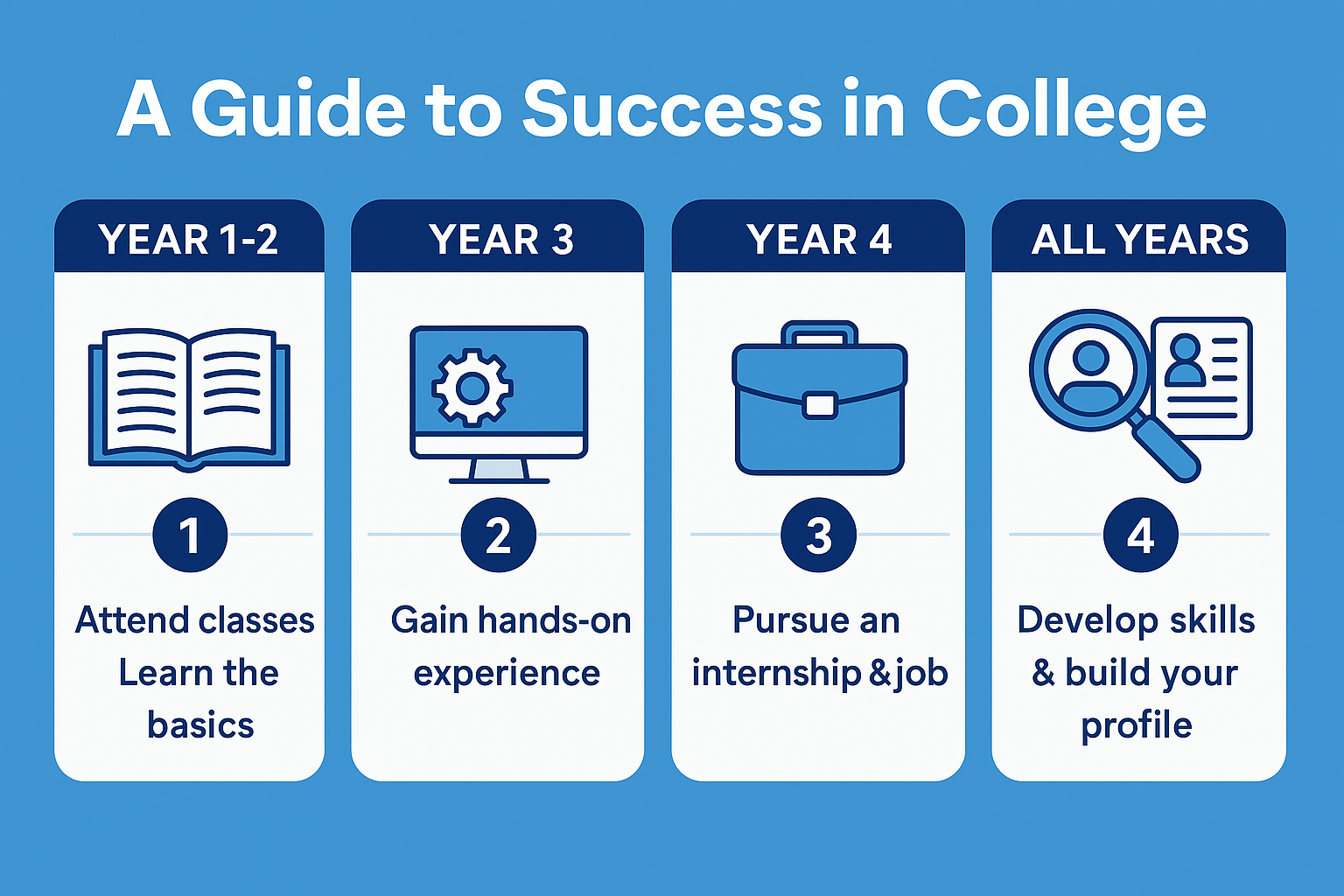
Year 1–2: Master the Fundamentals and Build Foundations
In the first two years of engineering, your primary job is to learn the basics inside out. Core courses in math, physics, and introductory engineering provide the theoretical foundation for everything that follows. It might not always be obvious how calculus or circuit theory will apply to real life, but trust that these fundamentals are critical. In fact, engineering programs front-load theory for a reason: “For the first solid year, possibly two, engineers learn the absolute basic mathematical backgrounds required for their field… Content can often feel random, and its application not immediately clear. Still, pushing through these foundational courses is worth it – they equip you with the problem-solving toolkit you’ll use later.
Attend classes regularly and aim for a strong GPA. High attendance and engagement in class will help you grasp concepts better and avoid last-minute cramming. Don’t listen to anyone who downplays grades – your CGPA does matter, especially early on. A strong GPA opens doors to scholarships, exchange programs, and later internships or co-ops (many companies use GPA cutoffs for initial screening). Moreover, maintaining good grades builds discipline. As one engineering graduate notes, “a high GPA does demonstrate a strong level of discipline and ability to learn quickly. However, remember that grades are not everything – they show you can learn, but not necessarily that you can apply. So excel in academics, but plan to gain practical experience too (we’ll get to that).
Lay the groundwork for professional skills. Use these early years to start developing good habits and skills outside the classroom as well. For example:
-
Time management: Create a study schedule and stick to it. Getting into a routine in 1st year will make tougher semesters much easier to handle.
-
Networking on campus: Introduce yourself to professors and join student clubs or technical societies. Participating in clubs (robotics club, coding club, IEEE, etc.) not only reinforces classroom learning but also builds teamwork and communication skills. Many freshmen and sophomores who engage in co-curricular activities find they start practicing soft skills like collaboration early.
-
LinkedIn profile: Yes, even as a first-year student, create a LinkedIn profile and keep it updated with your minor achievements (courses completed, skills learned, any projects or volunteer work). LinkedIn is an excellent resource for building a professional network and gaining exposure to industry opportunities – it’s never too early to start. Connect with peers, seniors, and professors; you’ll be surprised how these connections can help with internships and insights down the road.
Finally, don’t be afraid to explore. While focusing on classes is key, use free time in summers or holidays to dabble in different domains that interest you – be it a programming language, a design tool, or a bit of electronics tinkering. The stakes in first year are low, so it’s a good time to find out what genuinely excites you. Just balance these explorations with your academic priorities.
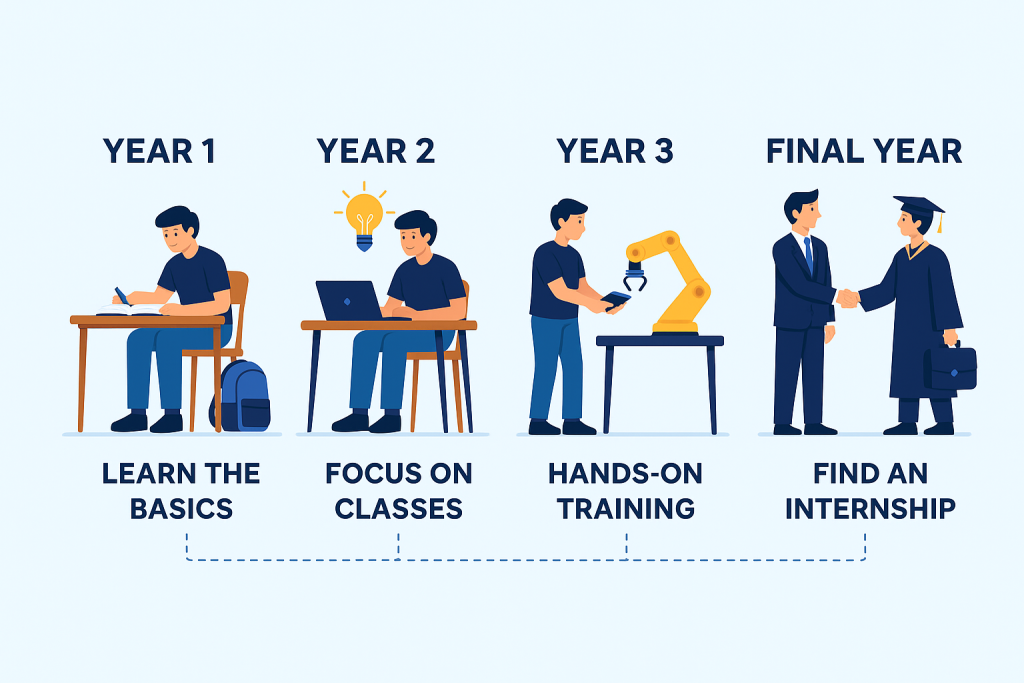
Year 3: Gain Hands-On Experience and Develop Projects
By the third year, you will notice a shift in your coursework. Classes move from broad basic science into specialized, applied engineering topics. Junior-year courses often integrate the fundamentals from years 1–2 and take a deeper dive into your chosen field. Many students find these classes more interesting due to their practical focus, but they can also be more challenging. This is where your solid foundation pays off. A strong grasp of first- and second-year material is crucial, as “third-year engineering courses shift from basic science to more applied, hands-on learning… and a solid understanding of fundamentals from the first two years is crucial”. In other words, if you paid attention early on, you’ll be well-prepared to tackle advanced topics; if not, now is the time to quickly shore up any weak areas.
Focus on projects and practical skills. In 3rd year, make it a goal to develop something tangible outside the exam paper – a project, prototype or research experience that aligns with your future goals. This could mean:
-
Undertaking a design project: Many programs have a mini-project or design course in third year – take it seriously. If you’re in software, build an app or a small software tool. If you’re in mechanical, perhaps design and fabricate a device or a drone in the lab. Working on a project forces you to apply classroom theory to real-world problems. It also teaches you to use engineering tools and software in practice. Often, “the most applied experience an engineering student can get is outside of a classroom”, so seek out hands-on challenges.
-
Joining competitions or hackathons: Participating in hackathons, coding competitions, or engineering contests (like Formula SAE, robotics competitions, etc.) in your third year can be incredibly rewarding. These events simulate real-world constraints – teamwork, tight deadlines, problem-solving under pressure – and they’re fun. Plus, any awards or even just participation can beef up your resume.
-
Summer internships or research: Between your 3rd and 4th year, try to land an internship or a research assistant position. Even if some top companies prefer senior interns, many do hire third-year students. You might not get your dream internship right away, but any practical exposure is valuable. Working in a lab with a professor or contributing to an open-source project are other ways to get practical experience if industry internships are scarce.
Hands-on experience will set you apart. Employers love to see initiative. One former engineering student observed that having projects or club experience can make you stand out to recruiters more than a high GPA – companies know a good GPA means you’re smart, but they also want to see that you can build and create. For example, students who joined engineering clubs (like a solar car team or coding club) often credit those projects for helping them land internships at top tech companies. Use your third year to start creating something you can showcase on your resume and discuss in interviews.
That said, don’t neglect your studies in year 3. This is typically one of the most demanding academic years, as junior-level courses expect you to retain and integrate knowledge from earlier classes. Stay organized and keep your grades up, as you’ll likely be applying for internships or considering grad school soon. It’s a busy year – juggling projects and tougher courses – but it’s the ultimate “are you an engineer?” test that prepares you for the final year and beyond.
Year 4: Internship and Launching Your Career
Your final year is the bridge between college and the professional world. By now, you should leverage everything you’ve learned – both in theory and practice – to secure an internship and prepare for your first job.
Do an internship (for ~6 months if possible). Many engineering colleges and universities allow or even require a semester-long internship in the final year. Grabbing such an opportunity can be a game-changer. Working at a good startup or a product-based company for six months lets you apply your skills to real projects and understand how companies operate day-to-day. The experience is invaluable: internships are often stepping stones to a first job, providing “valuable experience, training, and confidence” that you simply can’t get in a classroom. You’ll learn how teams collaborate on code or designs, how products go from concept to delivery, and how to navigate workplace communications. Additionally, internships build professional soft skills like time management, communication, and problem-solving in a real-world environment – skills that employers highly prize in new graduates.
There’s also a practical upside: internships frequently turn into job offers. Statistics show that a high percentage of interns receive full-time offers from their internship employers or have a much easier time landing a job elsewhere. For instance, one survey found paid interns have roughly double the likelihood of securing employment after graduation compared to students with no internships. Even if an internship doesn’t result in an immediate job offer, it significantly boosts your resume and networking contacts. Treat your internship like a 6-month job interview – be punctual, proactive, and eager to learn. It could very well lead to your first post-college job.
Focus your job search on your goals. In the final year (and during your internship), start looking for full-time roles that align with your career plan. If you discovered in third year that you love, say, data science or circuit design, target those domains in your job search. Use campus placement offices, online job portals, and your LinkedIn network to find openings. By this time, your LinkedIn should be populated with connections and a record of your projects and internship – recruiters do notice this. In fact, LinkedIn is a popular spot for hiring managers seeking fresh talent, and a student with a strong profile and active presence gains boosted visibility to potential employers. Set up job alerts on LinkedIn or other platforms so you don’t miss opportunities.
When applying and interviewing, leverage everything you’ve done in the past four years: your solid grades (they reflect your ability to learn), your projects (they show initiative and applied skills), and your internship experience (it proves you can work in a team and solve real problems). All these pieces combined make you a compelling candidate. By focusing your efforts through each year, you’ll find that upon graduation you’re not scrambling – you’ll have a portfolio of experiences and a clear direction for your career.
Beyond Classes: Develop Skills, Networks, and Habits Continuously
While each year has its academic focus, some aspects of your development span all four years. Successful engineers cultivate not just technical knowledge, but also professional skills, networks, and personal growth from day one:
-
Communication and Soft Skills: Engineering is as much about teamwork and communication as it is about technical prowess. In the workplace, you’ll frequently work in teams and interact with people from diverse backgrounds – so start honing those soft skills now. Join group projects, take on leadership roles in student clubs, or even volunteer for event organizing. Such activities improve your communication, teamwork, and leadership abilities. Remember, “soft skills are as critical as technical knowledge for engineers” – over 75% of employers say so. Being able to articulate your ideas and listen to others will amplify the impact of your technical skills. From giving presentations on your project to simply writing clear emails, these abilities will set you apart. As you progress through college, challenge yourself to step outside your comfort zone: present a paper at a student conference, or teach junior students as a tutor or TA. These experiences build confidence and communication skills that enhance your technical expertise.
-
Technical Tools and IT Skills: Modern engineering jobs demand proficiency with various software and tools. Make it a point to learn the industry-standard tools in your field. This includes general productivity software – for example, Microsoft Excel and Word for data analysis and report writing – which every engineer should know how to use. It also includes field-specific tools: a mechanical or civil engineer should get comfortable with CAD programs (e.g. AutoCAD or SolidWorks), an electrical engineer might learn simulation tools like MATLAB, and a computer science student should master coding environments and version control (Git/GitHub). By graduation, you should be “very proficient in both the Microsoft Office programs as well as discipline-specific software”. Don’t wait until the last minute – start learning these tools in small chunks throughout your 4 years, perhaps through online courses or elective classes. This also applies to emerging AI tools and programming languages. The tech landscape evolves quickly; showing adaptability and willingness to learn new technologies (like AI-driven tools, data science libraries, etc.) will future-proof your skillset. For instance, you can experiment with AI coding assistants or data visualization tools during projects to both enhance your results and get familiar with the next-generation workflows.
-
Online Presence and Networking: In the digital age, your online presence can be your calling card. We mentioned LinkedIn – continue nurturing it. Treat your LinkedIn profile like a dynamic resume: update it with every new project, internship, course certification, or achievement. Engage with content relevant to your field (share an interesting article or comment on industry news) to signal your interests. Networking is not about immediate gains but long-term connections. A comment or message to an alumnus now could lead to a job referral later. Also, consider maintaining a GitHub profile if you’re in a software-related field – upload your code from projects or labs there. Recruiters often appreciate a portfolio of code or designs. Similarly, join communities on platforms like Discord, Stack Overflow, or Reddit relevant to your interests (there are Discord servers for programmers, electronics enthusiasts, machine learning hobbyists, etc.). Being active in these communities helps you learn informally, find mentors, and even collaborate on fun side projects. It builds your network beyond campus and keeps you in the loop about real-world tech trends.
-
Continuous Learning Mindset: Perhaps the most important habit to cultivate over four years is being a self-driven learner. The technology and tools you learn in college will evolve; the only way to stay relevant is to keep learning continuously. Take advantage of online resources (MOOCs, YouTube tutorials, forums) to supplement your college curriculum. If a particular domain excites you – say renewable energy or artificial intelligence – don’t wait for a formal course; explore it through online courses or personal projects. This initiative not only deepens your knowledge but also signals to future employers that you are proactive and passionate. An engineer who is curious and adaptable will thrive in the fast-paced tech world. So, nurture your curiosity: ask questions in class, seek answers outside of it, and never hesitate to pick up a new skill.
Conclusion: Small Steps Every Day, Big Results After Four Years
It’s normal to feel overwhelmed when looking at all the things you could or should do in college – attending classes, acing exams, doing projects, networking, learning extra skills… it’s a lot! But remember, you have roughly 4 years (or 1460 days) to work with. If you break down your goals into daily or weekly habits, you’ll be amazed at what you can accomplish over the course of your degree. Consistency is key. Every lecture attended, every new connection made, every extra skill learned adds up. By steadily investing time in yourself – whether it’s one hour a week on LinkedIn networking or a few hours each semester on a side project – you will build an impressive skillset by graduation.
Staying focused from the beginning doesn’t mean you can’t have fun or deviate from a rigid plan. It means being mindful that your future is shaped by how you spend your present. Treat your first year as the foundation, your middle years as the time to experiment and gain experience, and your final year as the springboard to launch your career. With a clear vision and consistent effort, you’ll graduate not just with a degree, but with the confidence and readiness to step into the professional world. Engineering success is built day by day – start early, stay focused, and your future self will thank you for it. Good luck! 🚀