Hey buddy…do you want to publish articles like this on gbhardwaj.com?
If yes, then send your article (with images) to gauravbhardwaj@rjit.ac.in
Also, scan the QR code or click the link below to join the WhatsApp group for regular updates.
https://chat.whatsapp.com/ISKFnc0OvoM1W7bAvybWPG

The role of Technology in Defence
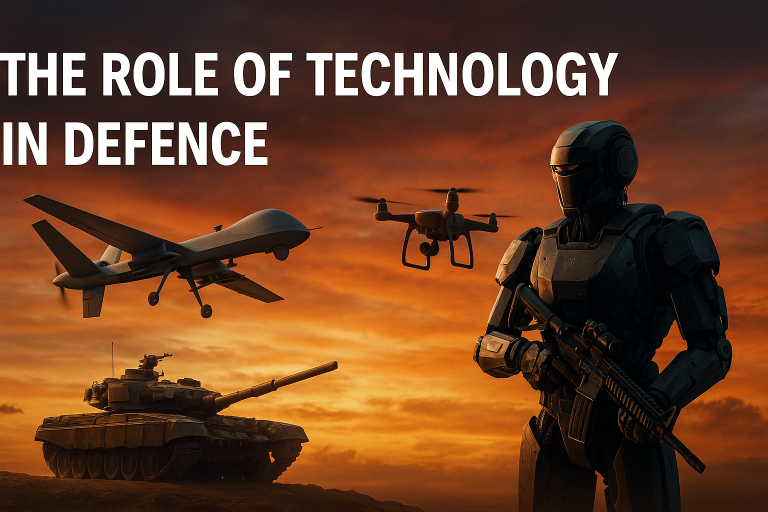
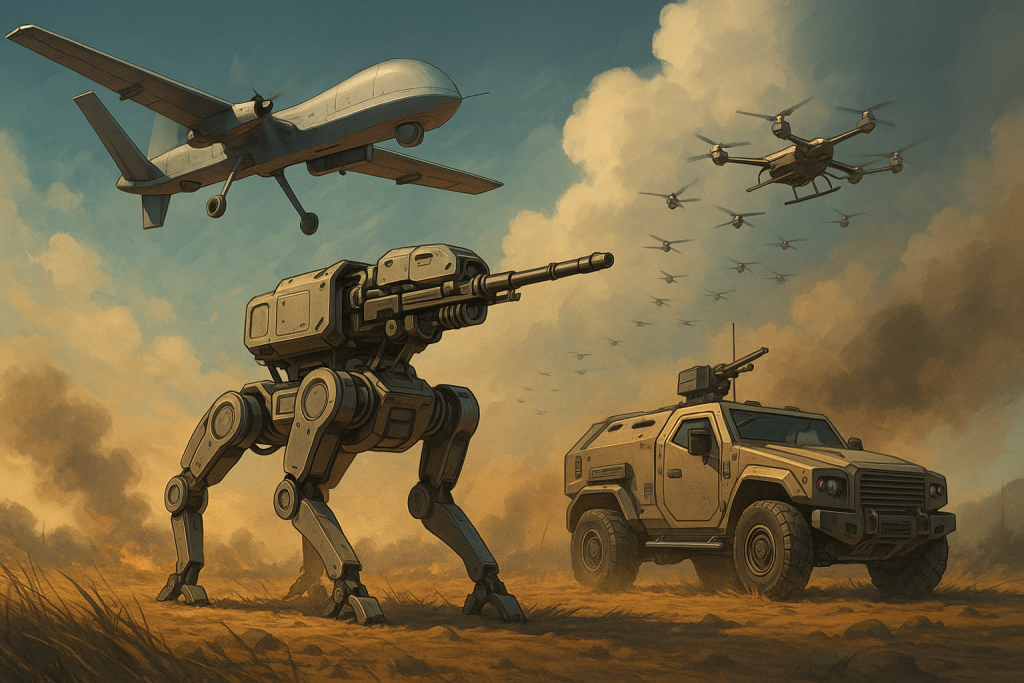
Modern militaries are increasingly deploying unmanned systems – from aerial drones to ground robots – to carry out missions that would be too risky for human soldiers. In recent conflicts, drones have proven game-changing. The 2020 Nagorno-Karabakh war, for example, has been called “the first war won primarily with unmanned systems”vox.comvox.com after swarms of armed drones helped Azerbaijan overwhelm traditional defenses. In the ongoing Russia-Ukraine war, both sides rely heavily on unmanned aerial vehicles for surveillance and strikes, and Ukraine has even fielded remote-controlled robotic vehicles to deliver supplies and evacuate wounded troops. Every time a robot or drone takes on a dangerous task, it means a human life is spared – as one Ukrainian soldier put it, “Every time a drone or a robot does something, it means one of our fighters doesn’t have to… the machine doesn’t get tired”fastcompany.com. These machines, which can range from small quadcopters to tank-like robots, are expendable hardware. Losing a drone or robot is a financial hit, but it saves the precious lives of soldiers on the ground. Militaries around the world – from the United States and Israel to China and India – are investing in ever more capable unmanned systems, aiming to keep their warfighters out of harm’s way while maintaining effectiveness on the battlefield.
Small drones flying in formation demonstrate the growing role of autonomous swarms in modern warfare. Such drone swarms can overwhelm enemy defenses and continue a mission even if some units are lost, showcasing the resilience and force multiplication that technology provides.
Artificial Intelligence and Autonomous Warfare
Cutting-edge artificial intelligence (AI) is the force behind many of these new defense technologies. AI enables autonomous or semi-autonomous operation of drones, robots, and decision-support systems. For instance, militaries are experimenting with drone swarms controlled by AI algorithms that coordinate dozens of drones simultaneously. India recently approved an ambitious long-range swarm drone program where 20% of the drones in a swarm will carry sensors and onboard AI to guide the attack, helping the other 80% that carry warheads to hit their targets with precisionnews.ssbcrack.comnews.ssbcrack.com. Such swarms can autonomously regroup, adapt to jamming, and select targets, illustrating how AI gives a technological edge in combat. Beyond drones, AI also enhances surveillance (through automated image analysis and pattern recognition), targeting (e.g. identifying threats faster than a human can), and even strategic decision-making via simulations. Countries like the U.S., China, and Russia are racing to develop autonomous combat vehicles and “loyal wingman” AI-driven aircraft that can accompany piloted jets. These advances raise new challenges – from ethical questions about autonomous lethal systems to the need for robust safety and control – but they also promise to make militaries faster, smarter, and more adaptive. Harnessing AI in defence can multiply a nation’s combat power and deterrence capability without proportional increases in manpower.
Cyber Warfare: The Digital Battlefield
Technology’s role in defence is not confined to physical weapons – it extends into cyberspace. Modern conflicts include a silent war in the digital domain. Sophisticated cyber attacks can cripple enemy communications, air defenses, power grids, or supply chains without a single shot being fired. The Russia-Ukraine conflict exemplifies this trend: it is the largest military conflict of the cyber age and the first to feature extensive cyber operations by all sidescarnegieendowment.org. Both nations have engaged in hacking each other’s critical infrastructure and military networks, seeking to blind or disrupt the adversary. Cyber warfare units now exist in many armed forces, including India’s, tasked with both offense (like deploying malware or false information) and defense (protecting networks and databases). Electronic warfare – jamming or deceiving radars, communications, and GPS – is another facet of tech-driven defence, often overlapping with cyber tactics. In essence, the battlefield now spans the digital realm, where a well-timed cyber offensive can neutralize enemy capabilities before the first tanks or aircraft even move. This new front means countries must invest in tech talent and robust cybersecurity as much as in missiles and tanks. It’s a call for the next generation of defenders to be as fluent in code as they are with camouflage.
Indigenous Innovation: An Indian Perspective
From India’s point of view, technology in defence is not just about adopting new gadgets – it’s about achieving self-reliance and tailoring tech to national needs. India faces unique security challenges and cannot always depend on foreign suppliers for critical military gear. The country has therefore launched initiatives under the Atmanirbhar Bharat (self-reliant India) vision to boost domestic research and development in defence technology. A recent example is Operation SINDOOR, a limited conflict scenario in 2025 where India’s home-grown military tech was put to the test. In this operation, the enemy launched mass drone and missile attacks, but India’s integrated air defense network – including indigenous Akash surface-to-air missiles and anti-drone systems – formed an impenetrable shield, thwarting the threatiadb.in. The Indian forces also employed offensive tech like domestically developed loitering munitions (kamikaze drones) to strike high-value targets with precisioniadb.in. The success of Operation Sindoor showcased the payoff of investing in local innovation. As one analysis noted, India’s spectacular success in Operation Sindoor stands as a glowing tribute to the nation’s relentless pursuit of self-reliance in defence technology, fueled by an indigenous arsenal that delivered decisive superiority on the battlefieldiadb.in.
India is rapidly developing capabilities in drone swarms, robotics, artificial intelligence, and cyber warfare through organizations like DRDO, ISRO (for military space tech), and a growing private defense startup sector. The Indian Army has already inducted swarm drones for surveillance on its borders, and collaborative projects are underway to build AI-driven unmanned ground vehicles and autonomous sub-systems. By investing in home-grown technology, India not only saves costs but also ensures that critical equipment can be customized for local conditions and upgraded without external dependency. This push for domestic R&D also opens opportunities for young Indian scientists and engineers to contribute directly to national security. It aligns with the idea that the future of warfare will be determined by those who innovate – the nation that can create and control its technology will hold the strategic high ground.
Inspiring the Future: Invest in Tech for Security
The current trajectory of defence technology underscores a powerful message: to secure a nation’s future, we must innovate today. Governments and policymakers are urged to prioritize research funding, education, and industry partnerships in defense tech fields – be it AI algorithms, advanced materials, quantum cryptography, or next-generation drones. For India, this means cultivating centers of excellence and startup ecosystems that can design world-class military hardware and software on Indian soil. Such investment not only strengthens national security but also spurs high-tech economic growth.
This is also a call to students and researchers: your creativity and technical skills are as crucial to national defence as the courage of soldiers on the front. Whether you are coding an autonomous navigation system, engineering a more efficient drone engine, or devising strategies to counter cyber threats, you are contributing to saving lives and safeguarding sovereignty. The stories of drone swarms outsmarting traditional forces and cyber warriors defending networks should serve as inspiration. Technology is now as much a soldier’s armor as steel and Kevlar, and the lab is as important a battleground as the field. By pushing the boundaries of innovation, especially through indigenous development, we ensure that in future conflicts it will be our robots, drones, and algorithms on the frontline – absorbing the losses and risks – while our brave men and women are protected. The role of technology in defence is ultimately about preserving peace and freedom, and it’s a mission that demands the brightest minds and boldest ideas. Let us, as a society, support and accelerate this quest for a safer, tech-empowered tomorrow.